Xenon headlights provide substantially more light on the road than classic halogen headlamps. They increase safety when it is dark and are now found in almost all vehicle classes. Here, find out about the structure of xenon headlights and how they work. You can also find out what causes xenon ballasts to fail, how faults can be found quickly, and how dangerous it is to retrofit illegal xenon headlights.
The following technical information and practical tips have been compiled by HELLA in order to provide professional support to vehicle workshops in their day-to-day work. The information provided by Hella is intended for suitably qualified personnel only.
Xenon headlights are comprised of the gas discharge lamp, the xenon ballast, and the reflection and projector-type system. Bi-Xenon means that high beam and low beam are realised by a projection module. This has the advantage that only one ballast is required. This means that two light distributions with a large luminous flux are realised within the smallest installation space.
Through the use of a moveable cover, a purely mechanical switch between the light distributions for high beam and low beam is possible. This means that, aside from the actuating mechanics for the cover, there is no additional outlay for a separate headlamp with its own control electronics. The high beam light also reaches further and the areas to the side of the road are illuminated better.
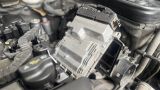
The electronic ballast (E) ignites the inert gas mixture in the bulb with a high-voltage pulse of up to 30 kV (4th generation). It causes a spark to flash over between the electrodes of the bulb. The electronic ballast controls the start-up of the bulb so the bulb reaches its operating phase quickly, and then controls the bulb power to a constant 35 W.
A DC converter generates the required voltage for the electronics and the bulb from the vehicle electrical system. The bridge circuit supplies a 300-Hz alternating voltage to operate the xenon bulbs. Several control and safety circuits are integrated in the device. Several control and safety circuits are integrated in the device.
The system is switched off within 0.2 seconds in the event of:
• A missing or faulty burner
• Damaged wiring harness or bulb part
• Differential current (fault current) greater than 30 mA; the switch-off time becomes shorter the greater the differential current
To protect the ballast electronics, a counting circuit ensures that a faulty bulb is only ignited seven times. After this, it is switched off.
If the cable connector is removed during operation, the voltage connections are practically voltage-free (< 34 V) after < 0.5 seconds, meaning that there is no immediate danger of electric shock should the warning notice not be complied with.
Xenon headlights look sophisticated and provide the vehicle with a top-class feel. This causes some drivers to upgrade their vehicles with xenon lights. They buy a set with cables, xenon light sources, and ballast, remove the halogen bulb from the headlamp, saw a hole in the cover cap, insert the xenon bulb into the reflector, connect the electronic ballast with the vehicle electrical system, and the xenon headlight is finished. But beware! This procedure endangers other road users because of extreme glare and is illegal: The general vehicle certification is rendered invalid, and insurance protection is restricted. Only complete, type-approved xenon headlight sets including automatic headlamp leveling and headlamp cleaning systems are legal.